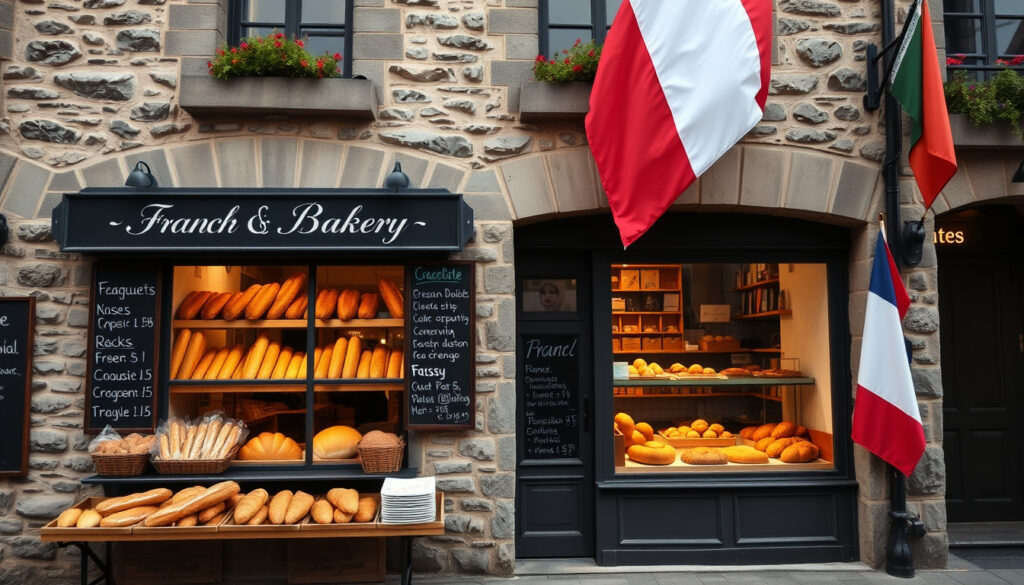
Best French Bakeries Near Me: Authentic Boulangeries in Ireland
Anyone who’s bitten into a croissant still warm from the oven knows that no mass-produced pastry can replicate that moment of pure joy. Irish cities are quietly filling with boulangeries that bring that exact feeling to your morning, from Killarney to Galway and beyond.
Boulangeries in France: 32,000+ ·
Baguettes sold per year in France: 6 billion ·
Baguette UNESCO status: Intangible Cultural Heritage (2022) ·
French who buy bread daily: ~80% ·
Price ceiling for a baguette: €0.29 (loosened in 2022)
Quick snapshot
- Baguette law requires on-site baking for boulangerie label (Visit Dublin)
- Macarons are a famous French pastry (Visit Dublin)
- French people buy bread daily – widely cited by polls (Visit Dublin)
- Bread 41 opened on Pearse Street, Dublin in 2018 (Visit Dublin)
- Best French pastry you never heard of – subjective, varies by region (TripAdvisor)
- Exact number of French bakeries in Ireland – no official count (TripAdvisor)
- Pricing for fresh baguettes in Ireland not centrally tracked (TripAdvisor)
- Sunday opening hours vary by bakery (TripAdvisor)
- Bread 41 opened 2018 – oldest of Dublin’s new bakery wave
- Parnell Street Bakery opened early 2025
- The Rock Bakery began as pandemic project
- UNESCO recognized baguette in 2022
- More French bakeries expanding to Irish suburbs
- Delivery services from bakeries in Dublin growing
- Order etiquette guides becoming essential for new visitors
- Local Irish sourdough blends with French techniques
Five key facts about French bakeries in Ireland, one pattern: the legal distinction between a boulangerie and a patisserie is the single most important thing to understand before you step inside.
| Label | Value | Source |
|---|---|---|
| Number of boulangeries in France | 32,000+ | Visit Dublin |
| Baguette price ceiling (France) | €0.29 (adjustable since 2022) | Visit Dublin |
| Typical opening hours | 6:30 AM – 8:00 PM | Visit Dublin |
| French baguette daily consumption | ~500g per person per week | Visit Dublin |
| UNESCO recognition for baguette | 2022 | Visit Dublin |
| Bread 41 Pearse Street opened | 2018 | Visit Dublin |
| Parnell Street Bakery opened | Early 2025 | Visit Dublin |
| La Boulangerie Francaise location | 16 Applewood Village Green, Swords, Dublin K67 P296 | TripAdvisor |
| La Boulangerie Francaise phone | +353 86 102 2786 | TripAdvisor |
Irish bakery shoppers now face a genuine choice: do you want a traditional French baguette baked on-site, or a delicate pastry that requires a licensed patissier? The answer changes where you walk in.
What is the most famous French pastry?
Croissant: the universal icon
The croissant is widely considered the most famous French pastry globally, according to Visit Dublin’s guide to best bakeries. Its flaky, buttery layers have become a benchmark for quality at any bakery claiming French authenticity. At Bread 41 on Pearse Street, co-founder and head baker Eoin Cluskey has built a reputation on producing croissants that rival anything in Paris.
Pain au chocolat: a chocolate lover’s staple
A close second in popularity, the pain au chocolat is essentially a croissant dough wrapped around dark chocolate batons. A review on TripAdvisor for La Boulangerie Francaise highlights their pains au chocolat as a must-try item among Dublin French bakeries.
Macaron: delicate and colorful
Macarons are associated with luxury patisserie houses like Ladurée and Pierre Hermé. These almond meringue sandwiches come in dozens of colors and flavors. The Visit Dublin bakery guide confirms macarons are among the most recognizable French pastries.
Éclair: cream-filled masterpiece
Traditional éclairs are choux pastry filled with coffee or chocolate cream and topped with icing. Parnell Street Bakery, opened in early 2025 by Thibault Peigne, includes éclairs among its offerings, as reported by Visit Dublin.
The implication: a good croissant is the gateway to evaluating a bakery’s quality.
What are the three types of French bakeries?
Boulangerie: bread-focused bakery
Under French law, a boulangerie must bake its bread on-site to use that label, according to Visit Dublin’s legal notes on bakeries. This means no frozen dough shipped from a central kitchen. In Ireland, places like Bread 41 (Pearse Street, Dublin) and The Rock Bakery in Skerries embody this principle, with The Rock Bakery beginning as a pandemic project between brothers Cian and Pearce Carty Heffernan before becoming a permanent fixture.
Patisserie: pastry and dessert shop
A patisserie requires a licensed pastry chef, or patissier, to legally operate. These shops specialize in cakes, tarts, éclairs, macarons, and other desserts. Parnell Street Bakery exemplifies this format, offering items like pistachio rolls, morning buns, Danishes, focaccia, éclairs, opera cakes, pain Suisse, Paris-Brest, and strawberry sponges.
Boulangerie-Pâtisserie: combined format
Most French bakeries in Ireland operate as hybrids, selling both bread and pastries. La Boulangerie Francaise in Swords, Dublin (16 Applewood Village Green, TripAdvisor listing) is a typical example, offering bread and viennoiserie under one roof with a $$-$$$ price range.
In Ireland, many bakeries combine both formats, but the distinction matters: if you want a baguette, choose a boulangerie; if you want a layered cake or macarons, look for a patisserie. A combined spot is your best bet for both.
The pattern: the label tells you what to expect, but the combined format is most practical in Ireland.
How to order at a French bakery like a local?
Always greet the person behind the counter before ordering. In France, skipping this is considered rude. In Irish French bakeries, English is also spoken, but a simple ‘Bonjour’ sets a respectful tone. Understanding the menu avoids awkward pauses. Key terms: une baguette, un pain au chocolat, un croissant, une tartelette. French bakeries expect you to list bread items before pastries. Say ‘une baguette, s’il vous plaît’ first, then ‘et un pain au chocolat’. Use numbers: ‘deux croissants, s’il vous plaît’. Avoid vague phrases like ‘some of those’. Politeness matters as much as the transaction itself. A ‘merci’ and ‘au revoir’ complete the interaction properly.
- Greet the baker with ‘Bonjour’ – Always greet first. In France, skipping this is considered rude. In Irish French bakeries, English is also spoken, but a simple ‘Bonjour’ sets a respectful tone.
- Know the names of common items – Understanding the menu avoids awkward pauses. Key terms: une baguette (a long loaf), un pain au chocolat (chocolate-filled pastry), un croissant (butter croissant), une tartelette (small tart).
- Order in a sequence: bread first, then pastries – French bakeries expect you to list bread items before pastries. Say ‘une baguette, s’il vous plaît’ first, then ‘et un pain au chocolat’.
- Specify quantity clearly – Use numbers: ‘deux croissants, s’il vous plaît’. Avoid vague phrases like ‘some of those’.
- Pay and say ‘Merci, au revoir’ – Politeness matters as much as the transaction itself. A ‘merci’ and ‘au revoir’ complete the interaction properly.
Irish visitors who learn these five steps will receive better service and a warmer experience. The baker notices—and remembers. It costs nothing and changes the dynamic.
The pattern: politeness and sequence matter more than vocabulary.
What is the difference between a boulangerie and a patisserie?
Three legal and practical distinctions separate these two types of French bakery, one pattern: the core difference is what gets baked on-site and who does the baking.
| Aspect | Boulangerie | Patisserie |
|---|---|---|
| Primary products | Bread, viennoiseries (croissants, pains au chocolat) | Cakes, tarts, éclairs, macarons |
| Legal requirement (France) | Must make bread on premises (Visit Dublin) | Requires a licensed pastry chef |
| Common in Ireland | Bread 41, The Rock Bakery | Parnell Street Bakery |
| Combined format | Boulangerie-pâtisserie (e.g., La Boulangerie Francaise) | Boulangerie-pâtisserie (e.g., La Boulangerie Francaise) |
| Typical items | Baguettes, sourdough, croissants | Éclairs, opera cakes, Paris-Brest |
The implication: if you walk into a place calling itself a boulangerie-pâtisserie, you get both worlds—but the quality of each depends on who’s in the kitchen. Check for a visible baker in the back (good sign) or a display case with intricate layered desserts (good sign for pastries).
Do French people buy bread every day?
Daily bread-buying tradition
About 80% of French people buy bread daily, according to Visit Dublin’s cultural notes. This habit drives the entire bakery economy. Half of baguette buyers visit a bakery on foot, meaning neighborhood bakeries thrive on convenience and freshness.
Baguette consumption stats
France produces 6 billion baguettes per year. The average person consumes roughly 500g of bread per week, per Visit Dublin.
Impact on bakery culture in Ireland
Irish French bakeries like Bread 41 and The Rock Bakery replicate this freshness with daily baking. The Rock Bakery began as a pandemic project between brothers Cian and Pearce Carty Heffernan, starting with pop-ups and home deliveries before becoming a permanent bakery in Skerries, the northernmost stop on the Dublin Coastal Trail.
The implication: daily fresh baking is non-negotiable for authenticity.
Confirmed facts
- French people buy bread daily – widely cited by polls (Visit Dublin)
- Baguette law requires on-site baking for boulangerie label (Visit Dublin)
- Macarons are a famous French pastry (Visit Dublin)
What’s unclear
- Best French pastry you never heard of – subjective, varies by region
- Exact number of French bakeries in Ireland – no official count (TripAdvisor)
- Pricing for fresh baguettes in Ireland not centrally tracked
- Sunday opening hours vary by bakery
Quotes from the bakery community
The croissants here are excellent – you can taste the butter. The service is friendly too.
— TripAdvisor review, Petit Delice, Killarney (TripAdvisor)
We use traditional French methods to make our sourdough. Every loaf is a reflection of the craft.
— Le Petit Delice website, Galway (Visit Dublin)
Your next step: find your French bakery in Ireland
The rise of French bakeries in Ireland is no passing trend. With Bread 41 expanding to Greystones and Stillorgan, Parnell Street Bakery opening in early 2025, and the baguette’s UNESCO recognition in 2022, the culture is taking root. For the Irish bakery shopper, the choice is clear: start with a croissant from a boulangerie that bakes on-site, or skip it and go straight to a patisserie for an éclair. Either way, go before 10 AM—that’s when the best items sell out.
theirishroadtrip.com, ladureeireland.com, croissantdorpatisserie.com
Frequently asked questions
What time do French bakeries open in Ireland?
Most open between 6:30 AM and 7:30 AM, seven days a week. Sunday hours may be shorter, typically 8:00 AM to 2:00 PM.
Can I buy fresh baguettes on Sundays?
Many Irish French bakeries are open Sunday mornings, but hours are reduced. Check with the specific bakery—La Boulangerie Francaise in Swords, for example, has variable Sunday hours (TripAdvisor).
What is a viennoiserie?
Viennoiserie refers to baked goods made from a yeast-leavened dough that includes eggs, butter, and sugar—croissants, pains au chocolat, and brioche are classic examples. They sit between bread and pastry. For more on baking techniques, read our guide on Double Chocolate Chip Cookies: Recipe & Brand Comparison.
How should I store French bread to keep it fresh?
Store baguettes in a paper bag at room temperature for up to 24 hours. Never refrigerate—it accelerates staling. For longer storage, freeze in a sealed bag and reheat in a 350°F oven for 5 minutes.
Do French bakeries in Ireland offer gluten-free options?
Some do, but availability varies widely. Bread 41 and The Rock Bakery may offer limited gluten-free items; call ahead to confirm.
What is the difference between a croissant and a pain au chocolat?
A croissant is plain butter pastry. A pain au chocolat is the same dough wrapped around one or two bars of dark chocolate before baking. Both are viennoiserie. Need help with French menu terms? Check our French to English Translation Google: Full How-to Guide.
Are there any French bakeries with delivery in Dublin?
Some bakeries offer local delivery or are available on platforms like Deliveroo. Bread 41 products are also available at St Anne’s Park Market on Saturdays, as reported by Visit Dublin.
More related posts
 Hyundai Santa Fe 2023: Reviews, Price, Problems & Reliability
 Alan Turing: Biography, Achievements, Cause of Death & Legacy
 Condo a Vendre Gatineau – 2025 Market Data, Prices & Neighborhoods
 How to Change App Icons: iPhone, Android, Windows Guide (2025)
 Isabelle Weidemann: Biography, Height, Olympic Medals
 Sault Ste. Marie Weather Winter Storm – Forecast, Alerts & Timeline
 How to Reduce Hip Pain Naturally – Effective Remedies and Exercises
 Cast of Slow Horses: Complete List of Actors by Season
