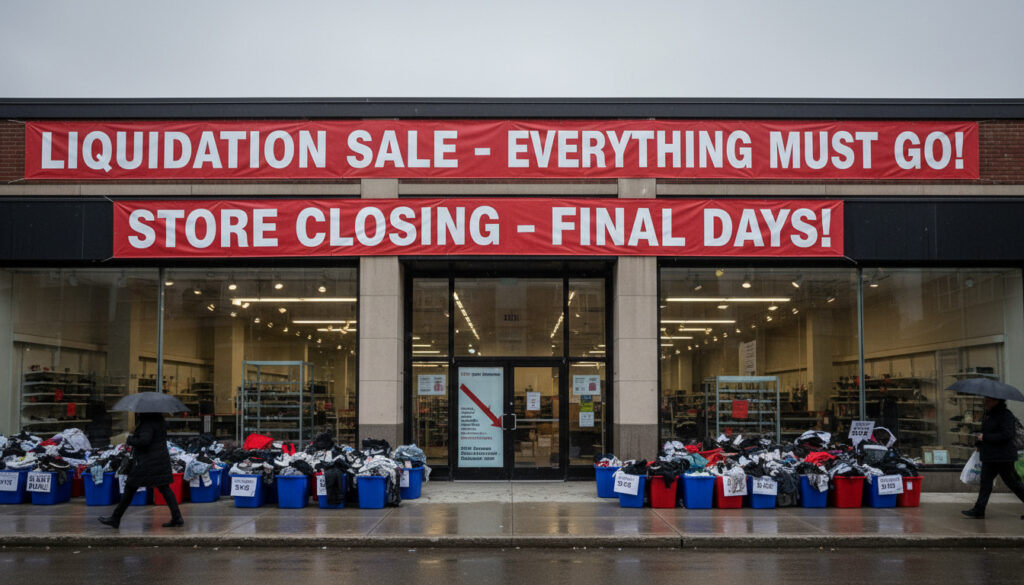
Hudson Bay Liquidation Sales – Closures Timeline and Facts
Hudson’s Bay Company, operating as The Bay, filed for creditor protection under Canada’s Companies’ Creditors Arrangement Act on March 7, 2025, initiating the permanent liquidation of all remaining Canadian stores and ending 355 years of continuous operation.
The historic retailer, burdened with over $1 billion in debt, operated 80 Hudson’s Bay stores, 3 Saks Fifth Avenue locations, and 13 Saks Off 5th outlets at the time of filing. By June 15, 2025, every physical location had ceased operations, marking the definitive end of Canada’s oldest company as a brick-and-mortar entity.
The liquidation affected 96 total stores nationwide, with final closures occurring in waves from late March through mid-June. The collapse eliminated approximately 9,300 positions and transferred key assets to Canadian Tire Corporation for $30 million CAD, fundamentally altering the Canadian retail landscape.
Is Hudson’s Bay Going Out of Business?
Legal Status
Filed for CCAA creditor protection March 7, 2025
Operational Status
Permanent cessation of all retail operations
Store Count
96 locations liquidated nationwide
Final Date
All locations closed by June 15, 2025
- HBC entered CCAA proceedings with liabilities exceeding $1 billion
- Liquidation sales commenced March 24, 2025, across the majority of locations
- Final wave of closures included 6 Hudson’s Bay stores and 1 Saks Fifth Avenue location beginning April 25
- Employment termination affected between 8,347 and 9,300 workers by June 1, with approximately 1,000 additional terminations by June 15
- Canadian Tire acquired intellectual property and trademarks for $30 million CAD
- Ruby Liu purchased 28 suburban leases, excluding flagship downtown properties
- U.S.-based Saks Global operates independently and was unaffected by the Canadian liquidation
| Fact | Details | Source |
|---|---|---|
| Filing Date | March 7, 2025 | Retail Dive |
| Debt Load | Over $1 billion | Chain Store Age |
| Total Stores Liquidated | 96 (80 Hudson’s Bay, 3 Saks Fifth Avenue, 13 Saks Off 5th) | Retail Dive |
| Liquidation Start | March 24, 2025 | Retail Insider |
| Final Closure Date | June 15, 2025 | Chain Store Age |
| Job Losses | 8,347–9,300 terminated by June 1; ~1,000 more by June 15 | Retail Insider |
| Asset Purchase | $30 million CAD to Canadian Tire (IP and trademarks) | Retail Insider |
| Lease Acquisition | 28 suburban leases to Ruby Liu | Retail Insider |
| Remaining Staff | 120 retained for wind-down operations | YouTube Report |
| Saks Global Status | Unaffected separate entity | Retail Dive |
Which Hudson’s Bay Stores Are Holding Liquidation Sales?
All 96 retail locations participated in the liquidation process. The initial phase encompassed 74 Hudson’s Bay stores and select Saks locations beginning March 24, 2025. The final phase, commencing April 25, 2025, included six remaining Hudson’s Bay stores and one Saks Fifth Avenue location previously earmarked for potential preservation.
Geographic concentration of final closures included three locations in the Greater Toronto Area and three in Quebec specifically situated in Montreal, Laval, and Pointe-Claire. Nine Saks Off 5th stores closed permanently on April 27, 2025, preceding the final department store closures.
Downtown flagship locations closed without lease salvage, representing a significant loss of retail anchor tenants in major Canadian urban centers. These properties were excluded from the 28 suburban leases acquired by Ruby Liu, leaving substantial gaps for brands that relied on HBC as Canada’s primary department store wholesaler, particularly in smaller markets.
What Deals Were Available at Hudson Bay Liquidation Sales?
Liquidation sales began March 24, 2025, at most locations, converting remaining inventory into cash to satisfy creditor claims. The sales encompassed all merchandise categories including apparel, home goods, and accessories across the 80 Hudson’s Bay locations and associated Saks properties.
Inventory Clearance Structure
The liquidation process followed standard CCAA procedures, with court-approved liquidators managing price reductions to maximize recovery values. Earlier rumors of promotional sales were subsequently confirmed as components of the broader liquidation clearance strategy initiated in late March.
Final Store Liquidations
The six Hudson’s Bay stores and single Saks Fifth Avenue location that entered liquidation in late April represented the last available inventory in the company’s Canadian network. These final sales concluded by June 1, 2025, leaving no remaining physical retail presence for the historic brand.
Why Is Hudson’s Bay Having Liquidation Sales?
Systemic Underinvestment
Retail analysts attribute the corporate failure to sustained disinvestment in physical stores and personnel following the 2008 acquisition by NRDC Equity Partners and chairman Richard Baker. Industry observers characterize the treatment of HBC as an “ATM” for ownership interests, drawing direct parallels to the earlier collapse of Sears Canada rather than attributing the failure primarily to customer abandonment.
Under U.S.-based ownership since 2008, HBC experienced chronic underfunding of store maintenance and staff development, gradually eroding the customer experience while extracting capital through real estate and operational leverage.
Economic Pressures
Court filings identified Trump administration tariffs and a challenging consumer environment as contributing economic stressors. However, the retailer’s fundamental decline predated the COVID-19 pandemic, which accelerated existing structural weaknesses rather than creating them. The Trump Canada 51st State – Origins Facts and Trade Context provides additional background on the trade tensions that complicated HBC’s final years.
Company filings cited specific trade policy challenges among the external pressures exacerbating HBC’s financial distress, though internal management decisions remained the primary driver of the insolvency.
Absence of Rescue Bids
The decision to liquidate the final seven stores resulted directly from the absence of viable acquisition bids for the reduced 6-store operational model. Potential investors determined that the remaining footprint lacked sustainable profitability, forcing the transition from restructuring efforts to complete wind-down.
Timeline of the Hudson’s Bay Liquidation
- March 7, 2025: HBC filed for CCAA protection with over $1 billion in debt, operating 80 Hudson’s Bay stores, 3 Saks Fifth Avenue stores, and 13 Saks Off 5th locations. Source: Chain Store Age
- March 24, 2025: Liquidation sales began at most locations nationwide. Source: Retail Insider
- April 25, 2025: Final six Hudson’s Bay stores and one Saks Fifth Avenue store entered liquidation, with sales commencing at these last holdout locations. Source: Video Report
- April 27, 2025: Nine Saks Off 5th stores closed permanently. Source: Retail Dive
- June 1, 2025: All Hudson’s Bay department stores permanently closed, terminating approximately 89-90% of the workforce. Source: YouTube Report
- June 15, 2025: Final Hudson’s Bay and Saks Fifth Avenue closures completed, ending 355 years of operations. Source: Chain Store Age
What Is Confirmed and What Remains Uncertain
Established Facts
- CCAA filing occurred March 7, 2025
- All 96 stores closed by June 15, 2025
- 8,347–9,300 jobs terminated without severance for many
- Canadian Tire purchased trademarks for $30 million CAD
- 28 suburban leases sold to Ruby Liu
- Richard Baker’s ownership since 2008 cited in analyses
Unresolved Questions
- Specific discount percentages applied during liquidation sales
- Future deployment of HBC intellectual property by Canadian Tire
- Potential reopening of any locations under different branding
- Long-term disability claim resolutions for terminated employees
- Final creditor recovery rates from the liquidation
Historical Context of the HBC Closures
The liquidation concludes 355 years of continuous operation for the Hudson’s Bay Company, originally founded in 1670 as a fur trading enterprise and evolving into Canada’s dominant department store chain. The closure eliminates the nation’s oldest continuously operating corporation and largest domestic department store retailer.
The disappearance of HBC’s physical footprint creates significant distribution challenges for consumer brands that relied on the retailer as their primary wholesale channel into Canada, particularly affecting smaller cities where alternative department store options remain limited. While Papa Johns Promo Code Canada – Verified Discounts March 2026 represents the type of promotional retail activity continuing in the Canadian market, the loss of HBC’s infrastructure fundamentally alters how goods reach consumers in many communities.
The collapse marks the second major loss of a historic Canadian department store retailer within a decade, following the 2017 liquidation of Sears Canada, suggesting systemic challenges in the mid-market brick-and-mortar sector that extend beyond individual corporate management failures.
Sources and Expert Perspectives
Industry analysis emphasizes that HBC’s demise resulted from ownership treating the company as a financial instrument rather than an operational retail business. The comparison to Sears Canada’s collapse reflects similar patterns of real estate extraction and maintenance deferral.
“The end of Hudson’s Bay department stores represents not just the closure of retail locations, but the termination of 355 years of Canadian commercial history, leaving significant gaps in the wholesale distribution network for numerous brands.”
— Retail Insider Analysis, June 2025
“Treating HBC as an ATM rather than investing in the customer experience created the conditions for this collapse, mirroring the Sears Canada trajectory.”
— Industry Expert Commentary, Retail Dive
Summary of the Hudson’s Bay Liquidation
Hudson’s Bay Company entered creditor protection on March 7, 2025, and completed the liquidation of all 96 Canadian stores by June 15, 2025, terminating approximately 9,300 positions and ending 355 years of operations. The collapse stemmed from systemic underinvestment under U.S. ownership since 2008, compounded by economic pressures including trade tariffs, with assets subsequently distributed to Canadian Tire and private investors while the Saks Global entity continues operating independently in the United States.
Frequently Asked Questions
Did all Hudson’s Bay stores close permanently?
Yes. All 96 Canadian locations including 80 Hudson’s Bay stores, 3 Saks Fifth Avenue, and 13 Saks Off 5th closed permanently by June 15, 2025.
When did the liquidation sales begin?
Liquidation sales began March 24, 2025, at most locations, with the final six Hudson’s Bay stores and one Saks Fifth Avenue starting sales April 25, 2025.
How many employees lost their jobs?
Between 8,347 and 9,300 jobs were terminated by June 1, 2025, with approximately 1,000 additional terminations by June 15, representing about 89-90% of the workforce.
What caused Hudson’s Bay to go out of business?
Systematic underinvestment in stores and staff since 2008 under U.S. ownership, combined with economic pressures including tariffs and declining retail conditions, led to the CCAA filing.
Did Saks Fifth Avenue in Canada close too?
Yes. All three Canadian Saks Fifth Avenue locations closed, though U.S.-based Saks Global remains a separate unaffected entity.
Who bought Hudson’s Bay assets?
Canadian Tire purchased HBC’s intellectual property and trademarks for $30 million CAD. Ruby Liu acquired 28 suburban leases, excluding downtown flagships.
Did workers receive severance packages?
Many terminated employees did not receive severance or long-term disability benefits, though 120 staff were retained temporarily for wind-down operations.
More related posts
 40 Fahrenheit to Celsius: 4.44°C + Formula & Chart
 Bre Tiesi: Age, Kids, Net Worth & Chrishell Lawsuit
 Tweedle Dee and Tweedle Dum – Origins, Story and Adaptations
 Hair Cuts for Men: 2026 Trends, Barber Rules & Best Cuts
 Criminal Minds Season 19: Release Date, Cast & FAQs
 Bill C-2 Canada: Strong Borders Act Summary and Latest Update
 Papa Johns Promo Code Canada – Verified Discounts March 2026
 Celtic v 76er Match Player Stat : Game 7, Tatum Out, Owner hip New
