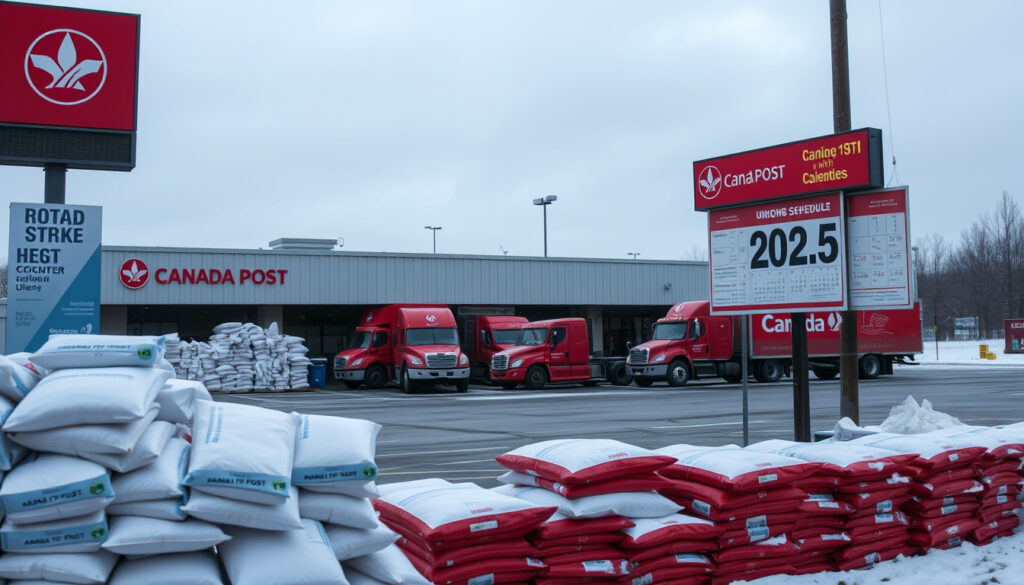
Canada Post Strike: Union Rotating Schedule & Impacts 2025
If you’ve checked your mailbox recently and found it emptier than expected, you’re not alone. Since mid-October 2025, the Canadian Union of Postal Workers (CUPW) has been running rotating strikes across Canada Post facilities—a strategy designed to keep mail moving while maintaining pressure on management. Whether you’re waiting on a package or simply curious about what’s happening with your postal service, here’s what you need to know about the ongoing labour dispute.
Recent Losses: $1 billion in 9 months · Strike Start: September 25, 2025 · Union Involved: CUPW · Current Status: Rotating strikes ongoing · National Suspension: October 10, 2025
Quick snapshot
- Rotating strikes active since October 11, 2025 (Canada Post Official)
- National strike lasted 2.5 weeks before shift (AMZ Prep)
- New commercial volumes suspended until October 15 (Canada Post Official)
- Exact rotation schedule by location
- Confirmed resolution timeline
- Whether strike extends into holiday season
- September 25: National strike begins (AMZ Prep)
- October 10: CUPW announces shift to rotating (Wikipedia)
- October 11: Rotating strikes begin at 6:00 am (Canada Post Official)
- Negotiations continue between CUPW and Canada Post (Canada Post Official)
- On-time delivery guarantees remain suspended (Canada Post Official)
- Customers should expect ongoing delays (Canada Post Official)
| Label | Value |
|---|---|
| Union | Canadian Union of Postal Workers (CUPW) |
| Strike Type | Rotating since October 11, 2025 |
| Financial Loss | $1 billion in 9 months |
| Official Updates | Canada Post negotiations page |
| 2024 Strike | November 15 – December 16, 2024 |
| Contracts Extended | May 2025 |
What does a rotating strike mean for Canada Post?
A rotating strike differs from a full national work stoppage. Rather than halting all operations at once, CUPW targets specific facilities or regions in sequence. The result: mail continues flowing, but with delays concentrated in whichever location is on strike at a given time. This allows the union to sustain pressure on Canada Post without completely shutting down the postal network.
Definition of rotating strike
- Workers at targeted facilities stop work while others continue operations
- Rotations shift geographically, spreading disruption across regions
- Mail moves with slight delays rather than stopping entirely
Shift from national to rotating
After 2.5 weeks of a full national strike that began September 25, 2025, CUPW announced on October 10 that it would shift to rotating strikes. According to the union, the change reflects “our commitment to the public, charities, businesses, and our members” (Labor Notes). Canada Post resumed accepting new commercial volumes on October 15, 2025, as the network began clearing trapped backlog.
Union strategy behind it
CUPW frames rotating strikes as a way to reduce hardship on workers while keeping pressure on management. “Rotating strikes may slightly delay the mail and parcels, but they keep them moving,” the union stated (CUPW Official). By maintaining partial service, the union also aims to preserve public support that might erode during a complete shutdown.
Canada Post faces a stubborn dilemma: the rotating format prevents a total service collapse, but the sustained pressure makes backlog clearance difficult and keeps delivery unpredictable for weeks on end.
How do rotating strikes work?
Unlike a full shutdown where every worker walks out simultaneously, rotating strikes unfold in waves. CUPW coordinates strike action at one or more facilities while the rest of the network continues accepting, sorting, and delivering mail. The affected location changes over time, creating rolling disruptions rather than a single event.
Mechanics of rolling strikes
- CUPW selects specific Canada Post facilities for targeted action
- Workers at those sites halt operations for defined periods
- Other facilities process mail as normal, unless subsequently struck
- The cycle continues until the union calls it off or a settlement is reached
Scheduling and locations
CUPW has not published a public schedule of which facilities will strike and when. The union communicates rotation details internally, and Canada Post updates customers as disruptions affect specific locations. According to PostNow (PostNow), rotations shift regionally, limiting disruption to specific locations at a time rather than causing nationwide simultaneous stoppages.
Impact on operations
Canada Post acknowledged the operational challenge directly: “Shutting down and restarting parts of our integrated national network with rotating strikes has always challenged our ability to provide reliable service to customers” (Canada Post Official). Items already inducted into the network remain secure but undeliverable if their destination facility is struck.
Rural areas and P.O. box customers face disproportionate impact when their local facility strikes, since they lack alternatives that urban residents might access through private carriers.
Can I still receive mail during a Canada Post strike?
Yes, but with conditions. The rotating format means service is never fully suspended across the entire country, but delays vary depending on whether your local facility is actively on strike. Canada Post has warned customers to expect ongoing disruption as the network works through accumulated backlog.
Mail and parcel delivery status
- Deliveries continue at non-struck facilities
- Socio-economic cheques continued during the national strike phase (PostNow)
- Date-specific Neighbourhood Mail remains unavailable during the strike period (Canada Post Official)
- On-time delivery guarantees for parcels are suspended (Canada Post Official)
Expected delays
The shift to rotating strikes did not eliminate delays—it transformed them. Mail delivery resumed irregularly after October 11, 2025, with unpredictable service quality. According to AMZ Prep’s tracking (AMZ Prep), customers in affected regions have experienced waits extending well beyond normal delivery windows.
Alternatives for customers
- Private carriers (UPS, FedEx, DHL) operate independently of Canada Post
- Some retailers offer pickup at partner locations outside strike zones
- Check Canada Post’s website for facility-specific service updates
If you’re expecting time-sensitive mail—medications, legal documents, or holiday purchases—private alternatives are your safest bet. The rotating format means there’s no guarantee your area won’t be struck without warning.
Canada Post rotating strike schedule
CUPW has not released a public rotation calendar, and Canada Post updates customers reactively rather than proactively. The union announces which facilities are struck, but the timing and sequence remain internal coordination. Here’s what is known from official sources.
Current and upcoming rotations
Rotating strikes began at 6:00 am local time on October 11, 2025 (Canada Post Official). As of mid-October 2025, the strike remained ongoing in rotating format with no end date specified (AMZ Prep). The union has not announced a fixed rotation schedule.
Ontario-specific details
Ontario facilities have been affected periodically since the rotating phase began. According to tracking from PostNow (PostNow), major Ontario sorting centres have seen rotating action, though specific timing depends on union coordination. Customers should monitor Canada Post’s announcements for their region.
How to stay updated
- Canada Post negotiations page (Canada Post Official) for corporate updates
- CUPW website (CUPW Official) for union statements
- Local news outlets for region-specific strike activity
When will Canada Post strike be over?
No confirmed resolution date exists. As of mid-October 2025, CUPW and Canada Post remain at the bargaining table with rotating strikes ongoing. The 2024 strike lasted about a month before a settlement, but this dispute shows no signs of imminent resolution.
Negotiation status
Canada Post has urged CUPW to return to productive bargaining. “Shutting down and restarting parts of our integrated national network with rotating strikes has always challenged our ability to provide reliable service to customers,” the corporation stated (Canada Post Official). The union, meanwhile, rejected management’s offer as regressive and maintains strike pressure.
Recent developments
The timeline shows escalating action preceded by months of labour tension. CUPW served strike notice on May 19, 2025, initially shifting to an overtime ban starting May 23 (Wikipedia). The ban on unaddressed flyers began September 15, 2025, at 12:01 AM local time (PostNow), escalating to the full national strike on September 25.
Potential end dates
Global News has reported on strike risks extending into the holiday season (Global News), a period when postal volumes typically peak. This timeline creates pressure on both sides to resolve before December, though previous disputes have dragged through the holidays.
Key facts
Three key facts anchor any understanding of this dispute.
| Fact | Detail | Source |
|---|---|---|
| National strike began | September 25, 2025 | AMZ Prep |
| Shift to rotating | October 10, 2025 | Wikipedia |
| Rotating strikes began | October 11, 2025 at 6:00 am | Canada Post Official |
The dispute traces roots to contracts covering Urban and RSMC operations that were extended to May 2025 after the 2024 strike (Stamps.com). The prior strike ran from November 15 to December 16, 2024.
Confirmed vs. unclear
What we know for certain versus what remains uncertain shapes how customers should approach the situation.
Confirmed
- Rotating strikes ongoing per CUPW (CUPW Official)
- Delays expected per Canada Post (Canada Post Official)
- Commercial volumes suspended until October 15 (Canada Post Official)
- On-time guarantees suspended (Canada Post Official)
Unclear
- Exact end date
- Full resolution timeline
- Specific regional strike schedules
- Whether government intervention will occur
What the parties say
“Rotating strikes may slightly delay the mail and parcels, but they keep them moving. They also reduce hardship on postal workers, while maintaining pressure on Canada Post and the government.”
— CUPW (CUPW Official)
“Shutting down and restarting parts of our integrated national network with rotating strikes has always challenged our ability to provide reliable service to customers.”
— Canada Post (Canada Post Official)
“Our decision to move to rotating strikes… reflects our commitment to the public, charities, businesses, and our members.”
— CUPW (Labor Notes)
The stakes for both sides are high. Canada Post has reported losses of $1 billion over nine months, creating financial pressure to resolve the dispute quickly. CUPW, meanwhile, faces members who need wages and working conditions improved. The rotating strike strategy is designed to bleed Canada Post financially while avoiding the complete public-service collapse that might trigger government intervention.
Related reading: No Confidence Vote Canada · Trump Canada 51st State
Frequently asked questions
Is Canada Post strike ending?
No confirmed resolution date exists. Rotating strikes continue as of mid-October 2025, with negotiations ongoing between CUPW and Canada Post.
Why is Canada Post struggling?
Canada Post has reported financial losses of $1 billion over nine months, attributed partly to the labour dispute and its operational disruptions.
How much does Canada Post pay its employees?
Specific salary figures are governed by collective agreements between CUPW and Canada Post. The current dispute centres on wages, working conditions, and job security provisions in those agreements.
Is Canada Post on strike tomorrow?
CUPW has not published a public rotation schedule. Check Canada Post’s negotiations page for the latest updates on which facilities are affected.
What is a rotating strike?
A rotating strike targets specific facilities or regions in sequence rather than halting all operations at once. This allows partial mail service to continue while the union maintains pressure on management.
Canada Post strike 2025?
Yes, a national strike began September 25, 2025, and shifted to rotating strikes on October 11, 2025. The dispute remains ongoing.
More related posts
 Houses for Sale Grande Prairie – Current Listings and Prices
 Bear Creek Provincial Park Camping, Hiking & Beach Guide
 Sainte-Brigitte-de-Laval: Distance, History, Saint Brigid
 Classement Ligue des Champions de l’UEFA: 2025/26 Standings
 Celtic v 76er Match Player Stat : Game 7, Tatum Out, Owner hip New
 30 Inches in cm: Exact Conversion and Height Examples
 Jesse Gregory James: Biography, Controversies, and Life Now
 The Good Stuff with Mary Berg: Her Show, Life & Family
